Search Results
Featured Search Results
Search Results
Suggested Searches
How To
What is the source of water supply for data centers, and does their water consumption decrease water supply availability to Prince William County?
- Updated
- 1/29/2025
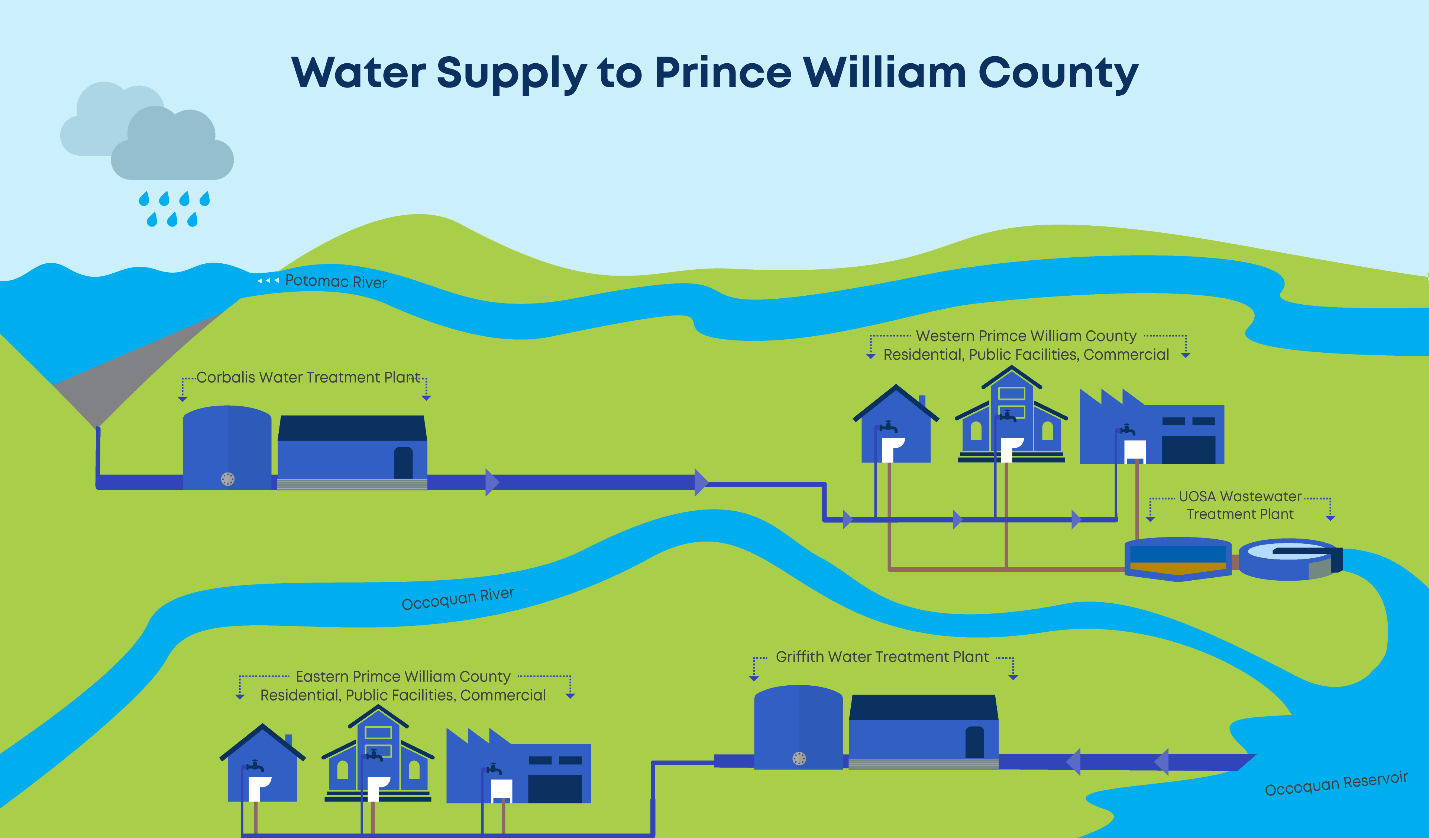
Data centers do not decrease water supply availability to Prince William County. Prince William Water’s system has eastern and western components, with drinking water supplied primarily by Fairfax Water. See graphic below.
Western Prince William County: Data centers are primarily located in the western areas of Prince William County. Western Prince William County drinking water is supplied by Fairfax Water’s Corbalis Water Treatment Plant, which draws from the Potomac River. Once used by data centers in western Prince William County, the wastewater is treated at the Upper Occoquan Service Authority Water Reclamation Plant and released as reclaimed water to the Occoquan Reservoir. In this water cycle, water used from the Potomac is reclaimed and released into the Occoquan Reservoir, adding volume.
- Eastern Prince William County: Drinking water for the east system is supplied by Fairfax Water’s Griffith Water Treatment Plant, which draws water from the Occoquan Reservoir. The eastern system does not supply data centers or other developments in western Prince William County and as a result development in western Prince William County effectively increases the water supply available to meet eastern Prince William County water demands.
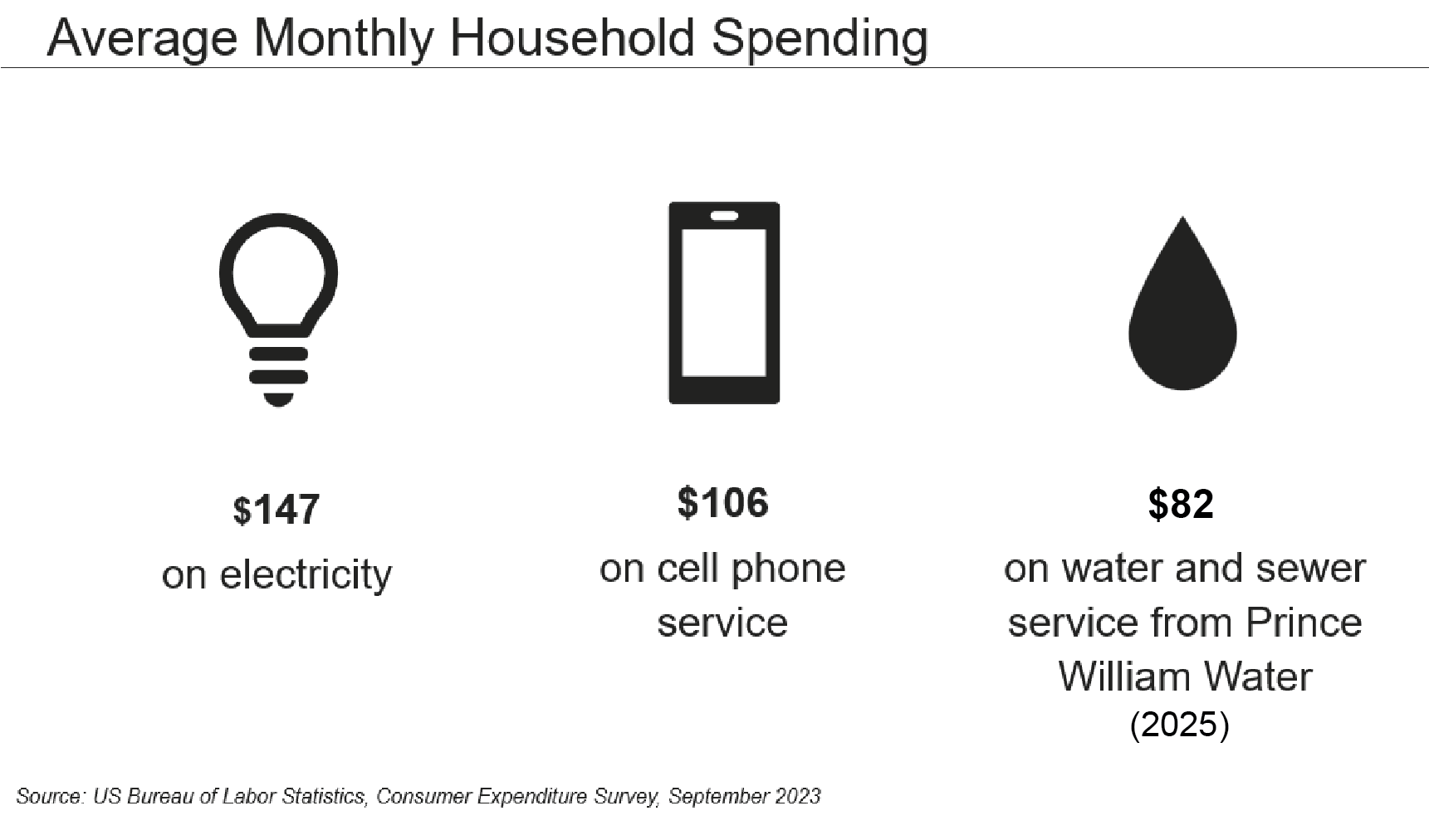
How does Prince William Water’s average monthly bill compare to other utility services?
- Updated
- 1/2/2025
What are the water and sewer rates and fees for residential and commercial customers starting January 1, 2025?
- Updated
- 4/27/2026
At its November 14th, 2024 meeting, the Board approved the rates included in this Public Notice, which details all rates and fees starting January 1, 2025. For additional questions, please contact Customer Service at (703) 335-7950 or customerservice@pwwater.org.
What are other local jurisdictions charging for water and sewer service?
- Updated
- 4/7/2026
In comparison with other local jurisdictions, Prince William Water’s rates remain competitive.
Local Jurisdiction | Estimated Water and Sewer Bill* | |
| Fauquier County | 153.02 | |
| VA American/Dale Service | 110.56 | |
| City of Manassas Park | 110.22 | |
| Virginia Average (TRC Survey) | 102.07 | |
| Stafford County | 100.58 | |
| City of Manassas | 97.14 | |
| Fairfax County | 91.79 | |
| Prince William Water | 88.85 | |
| Falls Church | 83.42 | |
| Loudoun County | 80.43 | |
| *Bill estimated based on 5,000 gallons per month for a single-family residential home as of January 2026. | ||
Water Testing Request (Priority)
- Updated
- 4/17/2026
Semiannual Lead & Copper Results
- Updated
- 5/7/2026
How can I reduce my water bill?
- Updated
- 1/2/2025
Review your water bill monthly so you are familiar with how much water your household uses throughout the year. Visit our Wise Water Use Tips page to learn about wise water use like checking for leaks and addressing them in a timely manner, monitoring outdoor water use, and other suggestions that might apply to your household. In addition, you can visit our Financial Assistance webpage for more information about financial assistance for your water bill.
What is Prince William Water doing about PFAS?
- Updated
- 10/7/2025
Prince William Water purchases treated drinking water from Fairfax Water and the City of Manassas to meet the needs of Prince William Water customers in Prince William County. Prince William Water remains fully confident in their ability to provide safe and reliable drinking water that meets regulatory treatment and distribution requirements. Read Fairfax Water's statement about PFAS.
Like our regional and national water utility colleagues, Prince William Water supports the EPA’s efforts to limit exposure to PFAS compounds, which enter the environment through industrial and household uses. While Fairfax Water has developed preliminary estimated costs to treat PFAS, including required infrastructure updates, this is an evolving topic and estimates may change. In addition, it is important to note that as only one of Fairfax Water’s wholesale customers, Prince William Water would only be responsible for our portion of the total costs. We will continue to work with our wholesale providers to address PFAS treatment in a cost-effective manner.
Prince William Water has been collecting and testing samples from our water distribution system for PFAS compounds since 2021. We will continue this sampling and reporting process and are working with regulatory agencies and our wholesale water providers to ensure that we maintain the safety and high quality of our drinking water into the future.
What were some of the drivers behind the rate and fee changes for 2025-2027?
- Updated
- 12/27/2024
Prince William Water’s goal is to set fair and equitable rates and fees while providing clean, safe, reliable drinking water to our customers and to protect the environment. This means ensuring that Prince William Water’s infrastructure is well-maintained and in good working condition, which requires a significant capital investment every year. The adopted rates for 2025-2027 are primarily driven by capital replacement needs, the rising cost of construction, as well as increases in purchased drinking water, purchased water reclamation services and other operating costs.
Prince William Water purchases most of its drinking water from advanced treatment plants owned and operated by Fairfax Water. Wholesale water rates charged by Fairfax Water have increased significantly over the past few years. Prince William Water also purchases water reclamation services from the Upper Occoquan Service Authority (UOSA) to serve a portion of our customers. Recently, UOSA treatment costs have also increased considerably.
In addition, the updated rates and fees are also required to properly maintain our infrastructure, meet or exceed environmental regulations, and continue delivering the high-quality, reliable service our customers expect from Prince William Water.
What is considered an affordable water and sewer bill?
- Updated
- 12/27/2024
Prince William Water’s average monthly bill is considered affordable or low burden using several affordability metrics.
The Environmental Protection Agency (EPA) recommends multiple affordability measures and guidelines for water and sewer service. The guidance originally developed by the EPA in relation to median household income states that customers’ bills under 4.0% of median household income are considered affordable.
To expand upon the view of affordability for households with lower incomes, several additional metrics have been developed over the years, including Lowest Quintile Residential Indicator and the Hours Worked metrics.
- The Lowest Quintile Residential Indicator approach evaluates a customer bill at the lowest quintile of income instead of median income, with a threshold of under 4% considered affordable.
- The Hours Worked approach evaluates the number of hours worked at the prevailing minimum wage to pay the typical residential water and sewer bill, with the threshold of under 8 hours worked deemed affordable.
Based on Prince William Water’s typical household consumption of 5,000 gallons per month, Prince William Water’s proposed monthly water and sewer bills for fiscal years 2025 through 2027 are less than 1% of median household income, under 2% for Lowest Quintile Residential Indicator and under 7.0 hours worked at minimum wage.
The rates that take effect in 2025, 2026 and 2027 continue to reflect Prince William Water’s average monthly bill as affordable and continue to place Prince William Water’s average bill among the lowest in the region.