


Behind the Tap: Episode 5
In Episode 5 of Behind the Tap, Director of Communications & Community Engagement Kathy Bentz and Director of Operations & Maintenance Doug Shoop talk about the pipes, pumps, processes and people needed to deliver reliable drinking water and wastewater services to our customers.
Listen to the podcast on Apple Podcasts or Spotify.
-
Kathy: Hello and welcome to Behind the Tap, Prince William Water’s podcast. We chose the name of this podcast because many people don't know what happens behind their tap. What happens before clean water reaches their home or what happens to waste water after they use it in the kitchen, the bathroom, or the laundry. During today's episode, we will highlight the pipes and pumps, the processes, and the people who make sure you have clean, reliable water service every day. Our guest is Doug Shoop, Director of Operations and Maintenance, who brings a ton of knowledge and experience about these water 101 topics. Doug, thanks for being with us today on Behind the Tap.
Doug: Thank you. Looking forward to our conversation.
Kathy: So, like many of the people we've interviewed, you're a longtime team member here at Prince William Water. Tell me a little bit about your role in the organization and what's kept you here for more than 15 years.
Doug: So, personally working with dedicated team of field staff technicians that have a firm belief in a customer first focus. Their full mindset is best quality service that they can provide. It's about serving the public and I think that's what's kept me in this industry for this this amount of time. Additionally, the role allows me to use my engineering and my field experience to be able to help staff assess, provide input, or just respond to challenges that maybe we've seen in O&M that others haven't seen in the industry. So, it gives us an opportunity to share that across other industries.
Kathy: So let's start with water 101 with what I mentioned in the introduction, talking about the pumps and pipes behind the system. Talk to me a little about the infrastructure that it takes to bring clean reliable water service to our customers.
Doug: Sure. I want to go back to what operations and maintenance actually is. It is a very large division here at Prince William Water and we're responsible for providing clean, safe water to our customers as well as conveying wastewater back to a wastewater treatment facility. The division is made up of five departments. The administrative which includes our 24/7 dispatchers, our collection and distribution department, which is responsible for underground infrastructure, our water wastewater facilities department which is responsible for above grade infrastructure, and then we have our info inflow and infiltration department which is responsible for assessing and inspecting sewer mains. And lastly, we have our fleet department which is responsible for ensuring our 200 plus vehicles and equipment are ready at a moment's notice for us to respond to customers. My role there is to make sure that they have the available people, resources, material, equipment available to perform their job every day. We manage about $1.2 billion worth of infrastructure and about two thirds of that, think of a glacier, about two-thirds of that is below the surface of the water, which is what collection distribution department takes care of. That includes about 2,500 miles of water and sewer mains and 46,000 valves. Additionally above grade, above the water surface, we have 22 water elevated water storage tanks, 68 wastewater pumping stations, 17 water booster pumping stations and 13,000 plus fire hydrants. It's a complex system that requires numerous processes to keep the water flowing to our customers and to return the wastewater back to a wastewater treatment facility.
Kathy: So you mentioned a couple things that lets me do, let's do a little water utility vocabulary lesson. You mentioned the term mains, which we talk about water and sewer mains inside the company all the time. What's a main?
Doug: Think of a straw. All right. A drinking straw. We have lines the size of 3/4 to 54 inches in diameter. So, it's very large. It's a straw that interlocks with one another. So, each straw locks in and creates a watertight conduit to move water to your kitchen sink or to move wastewater from your house to a wastewater treatment facility. Its sole purpose is to move a liquid.
Kathy: Another term you used is a booster pumping station. What part of the infrastructure is that? What's its purpose?
Doug: A water booster pumping station is the heartbeat of our system. Each station is outfitted with pumps to provide pressure. That pressure is needed to fill our elevated water storage tanks and to fulfill demands in the system as people use water. The elevated water storage tanks are used to stabilize the daily demands. If you think about lawn watering in the summer, folks water their lawn early morning and also trying to get a shower. So those tanks stabilize that demand. It provides enough water to do both. It also is used, a tank is used for emergency storage for firefighting purposes. That's the secondary purpose of them. All in all, the pump stations are there to move water to every customer at a set pressure every day.
Kathy: On the flip side, on the wastewater side, we have sewage pumping stations. Talk to me about what they do in our system.
Doug: So think of a sewage pump station. It's very similar to a water booster pumping stations, meaning the components are the same. They both have pumps, they both have controls, they both have valves. A sewer pumping station is there to collect wastewater that's delivered by gravity from homes into a low-lying area in the system. So, a lot of subdivisions in Prince William County, they're up on a hill or they're down in a valley, right? It's not it's not a flat topography. So, we take advantage of the gravity to get the sewer to leave businesses, homes and industries to the pump station. The pump station then lifts that sewer up and pumps it to the next available downstream sewer system. Eventually that goes to a wastewater treatment facility.
Kathy: So, it's a very complex system as you alluded to. All the pipes and pumps. What I want to shift to now are the processes behind getting this water service to our customers. Talk to me about your department, your division, particularly the preventive maintenance programs that you have.
Doug: Sure. So, preventive maintenance is, you know, it’s the number one thing for us. You think about your own vehicle, right? You want to keep the car running, you're going to do some preventative maintenance on it, whether it's change the oil, get new tires. So, the same thing happens in our system. Every system component has a preventive maintenance schedule. Our vehicles, generators, pumps, the valves, our hydrants. For example, we have a seven-year cycle to operate all 46,000 valves. And the reason we do that is if there happens to be a water main break, we know those valves operated, we can put less customers out because we have less valves to turn off to isolate the break. So, it's very important. Plus, it allows us to find them whenever the break happens, right? We know where they're at. We have a 10-year cycle to inspect our 1,200 miles of sewer mains and that's an internal inspection of the of the gravity sewer mains to see what the conditions like. Is there any defects in the pipe that we want to repair? And then we have a two-year cycle for our 13,000 hydrants. On top of that, I did mention generators. Prince William County has a very strong grid for power. However, you know, foul weather does happen and occasionally power does get interrupted. All of our pump stations, water and sewage pump stations are outfitted with generators to ensure reliable service in event of a power outage.
Kathy: You mentioned that a lot of our infrastructure is below ground, but with some of those preventive maintenance programs. Are those efforts things customers might see going on when they're out in the community?
Doug: Absolutely. So, a lot of the work that you might see is in the street. You'll see our trucks and our staff. They may be working on a sewer, cleaning it or inspecting it. You may see them alongside the road at a hydrant flushing it during flushing season in the spring. You may see them working on a water main repair. The offsite things like in an easement, we do clear our easements where our water mains and sewer lines cross open land, so to speak. We keep those clear so we have access if something does happen, we don't have to dig through the weeds to find our manholes and our valves. So, you may see them in the woods. You may hear chainsaws. They're basically clearing the easement to make sure that we have we have access to it.
Kathy: Clearly, preventive maintenance is a huge undertaking at Prince William Water and it's ongoing. Why? Why do such a time-intensive and labor-intensive process?
Doug: Sure. Preventive maintenance is the first step to reliability and ensuring that we have water and sewer available to our customers 24/7. You know, we measure reliability with our service reliability index. Commonly known here as the five nines. It means that, five nines means, we've maintained 99.999% of the time we've maintained water and sewer service to our customers with less than two minutes of outage per customer per year. Right now, we're averaging about a minute, minute and a half. So, it only gets better because of preventive maintenance measures and processes in place to ensure that we're taking care of our equipment so customers can rely on the water and sewer service that they have.
Kathy: Okay. We've talked about pipes and pumps. We've talked about processes. Now, the key that underpins it all, the people. Talk to me about the people behind all of this and keeping folks in water.
Doug: There's a large group of people that work day and night and again it's 24/7 365. We like to joke around O&M does not sleep. We have on-call staff from the entire division that take calls from our customers. They take calls from our 24/7 hour dispatch office as well. And we respond. Our response time goal is to respond within an hour. Right now we're about 22 minutes. So, we're doing well with that. When water main break season, there is a time of year when we see more breaks in the system. It's usually November through March. Sometimes that time will creep up a little bit, but the customer should still be, should still get a response from us within that 1-hour time, that 1-hour time frame. I think the big thing here is the people. The people are dedicated. They understand their job. They have the skills. We provide the opportunity to upskill them. They have the attitude of servitude to take care of the customer. We want to have the best customer service and that's what we strive for every day.
Kathy: So, in each episode, I typically ask the guests a common customer question. Given what you just talked about with 24/7 service and water main brakes, if a customer has a problem with their water service, that might be low water pressure in their home. it might be seeing a leak out in the street in front of their house. How can they report or contact us about a problem like that?
Doug: There's a couple ways. Our web page is one, report a problem. They can also call our customer service between the hours of 8 and 5 and our 24/7 dispatch, emergency dispatcher is available 24/7. So, there's three ways they can get a hold of us. There's also an email option, I believe, too, that they can email customer service. So, there's plenty of opportunities. We and we encourage it.
Kathy: Great. Now, one question I ask every guest on this is, what is one thing that you wish people knew about Prince William Water?
Doug: There's so many people, as the podcast is called Behind the Tap, taking care of this infrastructure. It's ours to take care of. We're responsible for it. We take accountability for it, and we take the responsibility seriously. It's the people that actually make the system work.
Kathy: Great. Thank you. Thanks. This was a great water 101 walkthrough. Really appreciate you being here today.
Doug: Thank you.
Kathy: Thanks for watching this episode of Behind the Tap. We hope you've enjoyed our walkthrough water 101 today. For more episodes, subscribe on YouTube, Spotify, or Apple Podcasts. You can also find Behind the Tap on our website. We look forward to seeing you next time on Behind the Tap.
Topics in this Episode
Learn more about the topics in this episode by visiting our other pages.
-
Learn what it takes to deliver nearly 12 billion gallons of drinking water and treat 10.1 billion gallons of wastewater per year.
-
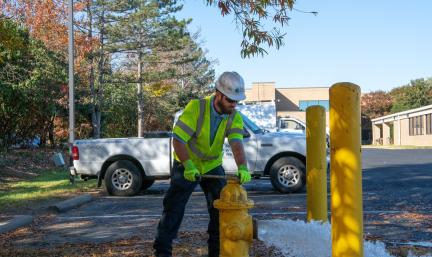
Discover the exciting career opportunities at Prince William Water.