


Behind the Tap: Episode 2
In Episode 2 of "Behind the Tap," General Manager/CEO Calvin Farr discusses the One Water framework and the partnerships involved in delivering safe, reliable drinking water to our customers.
Listen to the podcast on Apple Podcasts or Spotify.
-
Kathy: Hello and welcome to Prince William Water’s quarterly podcast, “Behind the Tap.” If you're looking for information about your water utility or how you can play a role in protecting our water resources, you're in the right place. Each podcast episode features a member of the Prince William Water team discussing current topics and answering questions from our customers. Today, our very special guest is Calvin Farr, who's the general manager and CEO of Prince William Water. Calvin, thanks so much for being here.
Calvin: Hello. Good morning. Good to be here.
Kathy: We love having you as a guest.
Calvin: Love being here.
Kathy: So, I want to start by asking a little bit about you.
Calvin: Yeah.
Kathy: You have been leading Prince William Water since 2021 and in the water industry for most of your career. What keeps you passionate about the industry and about working here?
Calvin: So, I'm going to tell you something you didn't know about your general manager. He's pretty fearless. When it comes to the industry, I would internally I tell myself I'm always up for the challenge. My passion really is about addressing challenges, coming up with solutions. Even way back in the day as a young engineer, by trade, engineering is my thing, right? It's always exciting to pop out of bed and be a part of a project to you know solves an issue like reducing sewer spills in the community or increasing water supply in a certain portion of the service area. So it has always been a passion of mine to address challenges and work with people doing so.
As I bring it to Prince William Water, same thing. It's the same thing that drives me. But also I’m excited every day to walk through those doors knowing that I have really awesome people here. I mean, we have a real sharp bunch of people with this organization. And not that they have to, but it seems like they have the same passion I have in regards to addressing challenges, doing the right thing for our community, working together, being team players. So, that adds to my passion, just kind of watching them do their thing. Really fortunate to be here and really, you know, honored to work with such a great bunch of people.
Kathy: Great. Thank you. So, let's switch and talk about our core subject for today's episode which is a concept called One Water. We hear a lot about One Water in the industry but for our viewers, talk about what that means and especially for us as a water utility.
Calvin: So as an engineer we box things in pretty constrained on our thought process and pretty rigid and traditionally as we're coming up in the industry we separate different things like water, wastewater, stormwater, groundwater, rightfully so. But now it's more about One Water and we have to understand that they're all connected. So, it's not a matter of we're just doing water and we're just going to you know, turn a blind eye to others that are doing wastewater or stormwater. So, One Water to me is really all about collaboration. So, we all have to be a part of managing water resources, very valuable, water resources. So, we have to work together. Saying we – departments, different organizations. Right? We are charged here at Prince William Water to provide drinking water and wastewater services. Those are our core mission, that's our core mission, but we can't do that actually in a silo. We have to work with other partners to deliver those services to our customers and our residents and our businesses.
Kathy: So, can you give me a couple examples how does One Water show up in the work that we do every day? Maybe in water reclamation, but some examples of it.
Calvin: So, drinking water. We send that drinking water. We make sure we provide safe, reliable drinking water to our customers here in Prince William County, but also, we reclaim that water also and treat it. So, what it looks like for us, for the average citizen, business, probably you'll see visually. Technicians responding to water main brakes. Maybe some folks turning valves, exercising valves. The residents, they don't necessarily see all the infrastructure we have. A lot of it's buried, of course. Almost 70% of our infrastructure is buried. You see water tanks, just kind of reminders that we are there and fire hydrants, you know. We don't stress enough about the importance of fire protection. We provide that. So, that's kind of how we show up. But when our citizens and businesses use this water, we reclaim it and they use it in a variety of ways and we collect that waste water and we treat it to a very high standard. We send it back into the environment to the local waterway and that's how we show up. In regards to this, really our part, in One Water approach. And again I can go in more detail about what it, the bigger, bigger, picture holistically in One Water for this region.
Kathy: Well, you mentioned earlier, collaboration being really important. What are, who are some of the partners we work with and what are some of the ways that we work with our partners?
Calvin: Yeah, so we partner with a lot of folks either informally or formally with agreements and things of that nature. So, one that that jumps out to me is Prince William County Government. As you know, we're a separate organization. For our world the Occoquan Reservoir is very precious to us. We work with the county on stormwater management. They oversee stormwater management, and we do aspects like public awareness about how we can protect the Occoquan Reservoir or different ways of looking at land use. And they're charged with making sure they reduce pollutants that get into the reservoir through stormwater management. So, we work with them regularly on that because the Occoquan Reservoir is actually a source of drinking water for the eastern portion of our county. So, it's in our best interest for us to work together.
Also, I've talked about us delivering drinking water to county residents and businesses. We also have got to be mindful that we have official partnerships and agreement with wholesale providers like Fairfax Water and City Manassas. They actually provide wholesale water to us, and we send it out to our service area. So, another partnership there.
We treat wastewater at the H.L. Mooney facility on the eastern portion of our county, and we partner with Upper Occoquan Service Authority which treats the western portion of the county. They treat that wastewater to a very high standard and they discharge that to the Occoquan which is a source of drinking water for us. We discharge to the Neabsco Creek, and our part is making sure that's to high standards. You know because it's part of the big Chesapeake Bay watershed improvement. So, like I said, everything is pretty much connected.
Also, we have partnerships with national and state trade associations really to make sure we implement the best practices. Also, we partner with regulatory organizations to make sure we meet limits and we're always compliant regulatory-wise and also, we're part of the legislative aspect too. You know the general assembly will be convening pretty soon so we'll be heavily involved in that too. So, there's a number of partners we have to talk with and work with just to deliver safe and reliable drinking water to our customers if you think about it right. So that's all one water. That's one example of ours.
Kathy: It's One Water with many hands taking part itself.
Calvin: That's right.
Kathy: So, we talked about how organizations can be part of the one water framework. Can individuals play a role in the one water approach?
Calvin: Absolutely. We need a lot of help from our residents. One that jumps out is recently, Thanksgiving holiday. We had fats, oils, and grease. We did the public awareness about that and I met with some citizens recently about, you know, don’t put grease down the toilet and sinks because it could gel up at some point and harden and then cause backups and then cause sewer main backups and it can get into the environment. You know, one of our jobs tasked is to make sure we don't have sewer spills. That's how we show up every day. That's one of our core business practices. So, we need folks to not do that.
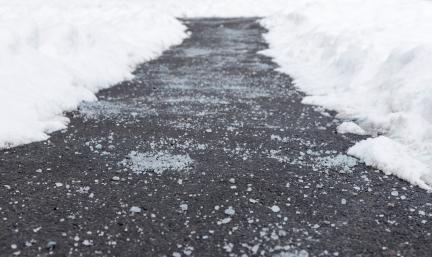
Also, we are in winter. We have the Salt Smarts campaign. I'm not sure folks are as aware as they are of FOG, but salts, if you use too much, it runs off. It's storm system, storm drains, and at some point, you know, in our world, it will go and convey into the Occoquan Reservoir. We're actually seeing sodium levels slightly increase over decades but that's one of the reasons why, because of the road salt. So, you don't have to use, you know, a whole bucket full of salt just for your driveway. You can use it sparingly. So that's one way.
But also, you know one thing is, in the perfect world for me is our residents really getting up to speed about their water. You know water and wastewater. We have a very informative website. It has a lot of information on it. I would love our folks to get educated; our citizens get educated. What I love every year is our Water Academy. We have citizens that join and it's amazing to me. Every time we have it somebody's always saying, "I didn't know you did all this kind of work." So really the education piece and just stay informed, and I think we can have a better community that way. Because my thing is our citizens will drive the decision makers in the county, right?
Kathy: Well, thank you for the conversation about One Water, but I have a couple more things for you. I want to switch gears. One thing we do in each episode is answer a commonly asked customer question, something that might come to our Customer Service department. It's winter. This episode is our winter episode. Can you tell me why it seems like there are more water main breaks in cold weather seasons than the rest of the year? Why does that happen?
Calvin: We're in a region where we have drastic temperature sways and changes. You know, we could go 20°, 30° weather change or temperature in one day. And just recently, the day before Thanksgiving was 70°, the next day was in the 40s. So that's the world we live in here in this region.
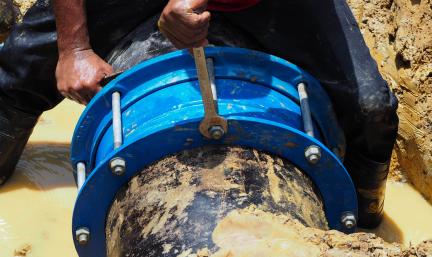
What happens there is when you have those drastic temperature changes that impacts the underground piping. The piping depending on the material contrast or move and if it's old then and brittle then it'll break. That's how that works. But also, if it gets real cold, you have soil that freezes and then when it thaws out soil kind of moves and it moves. Like, just say an old pipe that's been in the ground 60 years, it'll break typically. So that's why you see a big uptick of water main breaks in the wintertime because of the drastic weather changes that we typically see on an annual basis.
Kathy: And luckily, we've talked about in in other podcasts, our teams are really fast to respond to these.
Calvin: Absolutely. So, we have this measure called the five 9s, 99.999% water reliability or reliability, and we're under 2 minutes per customer [for outage time per year]. We expect these water main brakes, so it's not catching us by surprise. We prep for it on an annual basis. We have world-class technicians that are quick to respond. And they're very safe about it. And they're very prideful in meeting the five 9s. We're ready, you know. it's just responding and being safe and just being prepared for it, you know, and they do a great job at that.
Kathy: We have one more question that we are asking every guest on the podcast. What is one thing you wish people knew about Prince William Water?
Calvin: I'm going to tell you two things.
Kathy: All right.
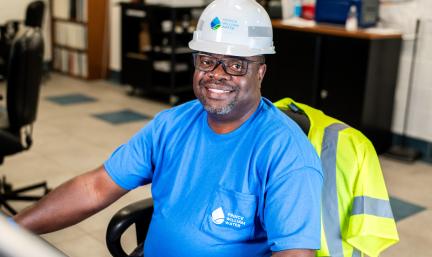
Calvin: And it's a plug for Prince William Water. We have a number of career opportunities here and I don't know if folks really know that. Typical customer will see our trucks drive by and see a meter reader or again a crew fixing a water main break. But we do way more than that. Of course you have the great technicians we have. Our meter reader reading folks are great. We also have accountants, budget folks, finance people, lab techs, you know, we have operators at the wastewater plant. We need electricians, mechanics, you know, there's a whole gamut, even those engineers, you know what I mean? It's a lot of career opportunities, not just principally in water, but overall, the water industry, the water-wastewater industry. And I'm not sure people know that. Hopefully, we can continue to get the word out and get more people interested in coming to the industry. And also come to Prince William Water.
The other thing too is it's really important for me, you know, for our county, community to really trust us. Yeah. That means everything to know that they trust us. And I'm not sure if they really know how good we are, you know. I can say it, but we get awards regularly. National awards on the great work we do and it's not just operations, it's how we complete projects even in your world of communications and public outreach. We get awards and I don't know if our customers really know that they have a trusted partner right and one of the best in America doing it. But now they will if they look at this podcast.
Kathy: Well, Calvin, thanks. Thank you for talking through the One Water concept and then some of your other thoughts about the industry. We really appreciate you being here.
Calvin: No problem. My honor and pleasure.
Kathy: Thanks. We appreciate you're watching this episode of Behind the Tap. We'll be dropping another episode in April, so be sure to subscribe on YouTube, Spotify, or Apple Podcasts. You can also find our podcast episodes on the Prince William Water website. We look forward to seeing you next time on Behind the Tap. [Music]
Topics in this Episode
Learn more about the topics in this episode by visiting our other pages.
-
Salt Smarts
Read about the environmental effects of road salt and how you can be salt smart in the wintertime.
-
Career Opportunities
Explore career opportunities at Prince William Water and learn about General Manager/CEO Calvin Farr's leadership philosophy.
-
Water Main Breaks
Learn how to recognize and report water main breaks as well as how Prince William Water responds to them.